
In a written reply, Singh said the 5G C-band spectrum has the likelihood of interfering with the current radio altimeters installed on the aircraft.

The last rites of Captain Sumeet Sabharwal, pilot in command of the Air India plane that crashed in Ahmedabad last week, were performed in Mumbai on Tuesday with his grief-stricken father bidding a heart-wrenching, tearful farewell to his son before the cremation.
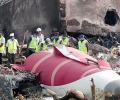
The lawsuit has compensatory and punitive damages against the defendants for the wrongful deaths of four passengers on flight 171, US-based law firm The Lanier Law Firm said in a statement.

The number of serious incidents has more than doubled in the last seven years.

The DGCA has asked airlines to inspect the fuel switch locking system in their Boeing 787 and 737 planes after a preliminary probe report into the Air India crash found that the switches were cut off before the accident.
The DGCA had conducted an enquiry into alleged lapses in conversion training of some pilots. After the conversion training, a narrow body pilot can operate wide body aircraft.
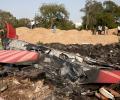
Air India Boeing 787-8 crash in Ahmedabad has brought back all traumatic memories.

The Air India plane AI-171 from Ahmedabad to London crashed immediately after take-off from the Sardar Vallabhbhai Patel Ahmedabad airport on Thursday, as per the Gujarat State Police Control Room.

'The real story of 2025 is that India officially stopped being a 'market of the future' and started acting as the world's primary economic engine.'
Aviation security watchdog BCAS has recommended installation of scanners based on computer tomography technology at airports whereby passengers will not be required to take out electronic devices from their hand baggage before going through the scanner. Currently, the scanners used at airports provide a two-dimensional view of the objects inside a hand baggage. Jaideep Prasad, Joint Director General of the Bureau of Civil Aviation Security (BCAS), on Wednesday said the regulator has proposed installing scanners based on computer tomography technology at airports that will provide a three-dimensional view of the objects in hand baggage.
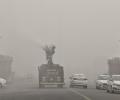
Delhi is preparing for its first artificial rain through cloud seeding to combat air pollution. A trial run was successful, and the first rainfall is expected on October 29 if weather conditions are favorable.
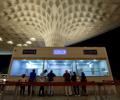
The octogenarian was asked to wait due to heavy demand for wheelchair.

Aviation security regulator BCAS on Wednesday slapped fines totalling Rs 1.80 crore on IndiGo and Mumbai airport operator MIAL over the incident of passengers having food on the airport's apron. The apron is the area around the aircraft where it has finally parked for deboarding.
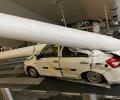
The Delhi airport, the country's busiest airport, on Friday early morning witnessed the collapse of a roof at Terminal 1 amid heavy rains that killed one person, prompting the government to order a detailed probe and an inspection of the structural strength of all airports.
The Supreme Court has criticized the selective publication of a preliminary report on the Air India crash, calling it 'unfortunate and irresponsible'. The court raised concerns about privacy, dignity of victims' families, and the potential for biased narratives.

'The ministry may like to consider setting up an ombudsman similar to electricity ombudsman and insurance ombudsman, to ensure a time-bound resolution of consumer issues within the airline sector.'

Vishwas Kumar Ramesh, the sole survivor of Air India's AI 171 crash, said he still cannot believe how he miraculously survived the accident of the ill-fated London-bound flight in which 265 people lost their lives.

Five pilgrims and a pilot onboard a helicopter had a narrow escape when the aircraft on its way to Kedarnath made an emergency landing on the highway in Rudraprayag district on Saturday after developing a technical snag during take-off, officials said.

An IndiGo flight from Delhi to Srinagar encountered severe turbulence after a sudden hailstorm. The pilot requested permission from Lahore Air Traffic Control to use Pakistani airspace to avoid the turbulence, but the request was rejected. The flight, carrying over 220 passengers, including Trinamool Congress MPs, landed safely at Srinagar Airport. The incident is being investigated by the Directorate General of Civil Aviation (DGCA).
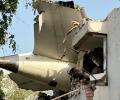
The specific reasons for the crash of the Boeing 787-8 aircraft flying from Ahmedabad to London Gatwick will be known only after the completion of the detailed probe by the Aircraft Accident Investigation Bureau.

A total of Rs 30,000 crore was allocated for five years to Air India by the United Progressive Alliance government in its second term.
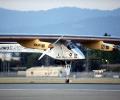
Fifty-six-year-old Piccard, who completed the first non-stop flight around the world in an air balloon in 1999, said he and his team were hopeful of getting permission for landing in the two Indian cities.
The DGCA directive called for a series of specific checks before each flight's departure from India, including inspection of fuel parameter monitoring systems, cabin air compressors, and electronic engine control units.
India's scores in the ICAO's air safety oversight audit will improve substantially as the international watchdog's just-concluded validation mission was highly successful as per the initial reports, regulator DGCA said on Wednesday. ICAO is the International Civil Aviation Organisation. Under its Universal Safety Oversight Audit Programme (USOAP) Continuous Monitoring Approach, an ICAO Coordinated Validation Mission (ICVM) was undertaken from November 9 to 16.
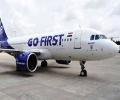
Aviation Working Group (AWG), a global aviation leasing body comprising major planemakers and lessors, on Monday further downgraded India as lessors have not been able to repossess their planes from Go First more than four months after the airline filed for insolvency. The leasing cost stands as a prominent expense for Indian airlines. With AWG's downgrade, it is likely that lessors will increase the aircraft leasing rates for Indian carriers.

India's aviation safety ratings have been downgraded by the Federal Aviation Administration (FAA) from the top to the second category, which would affect expansion of flights by Indian carriers to the United States.
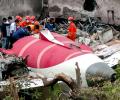
'... when the process isn't transparent, people will naturally raise questions. 'The AAIB's own press release says they had the black boxes by June 16.' 'Why wasn't decoding initiated until the 24th? What were they waiting for?'
Facing headwinds due to pilot exits, Akasa Air on Friday said it had approached the Delhi high court seeking interpretation and clarification with respect to mandatory notice period requirements for pilots and that the move was not against the DGCA or the civil aviation ministry. Akasa Air, which started flying in August last year, has initiated legal action against a "small set of pilots" who left the carrier without serving their notice periods that led to cancellation of many flights. In a statement, the airline said it sought relief from the Delhi high court to stop the unethical and illegal practice by this set of pilots.
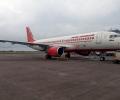
'A passenger on our flight AI130, operating London-Mumbai on March 10, was found smoking in the lavatory. Subsequently he behaved in an unruly and aggressive manner, despite repeated warnings,' Air India said.

Former Chief of Air Staff, Air Chief Marshal Arup Raha (Reired), on Saturday said the engine of the Air India aircraft that crashed near Ahmedabad airport on June 12 'definitely' lost power at a critical stage and there was no time for recovery.

This is the third enforcement action against a Tata Group airline in over a month.

On Friday, the Alaska Airlines plane's outer section, including a window, fell off mid-air.

The academy, a joint venture project, would conduct short term courses approved by the Director General of Civil Aviation and Transport Canada to train pilots and ground staff, Hemant H Shah, managing director of Cubex India.

"When the fuel control switch has to be cut off, the pilot flying will say, fuel control switch left, confirm. So, after the confirmation is made by the second pilot, the pilot monitoring will cut off (the switch).
Aviation watchdog Directorate General of Civil Aviation (DGCA) has asked Vistara to submit a daily report on flight cancellations and delays as the Tata group airline cancelled more than 50 flights for the second straight day on Tuesday amid non-availability of pilots.
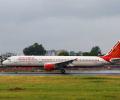
'...rectification has to happen then and there, and that takes additional time.'

'It is indeed a fact that several issues were routinely red-flagged by DGCA, and were addressed by the (Kozhikode) airport operator. These pertain to excessive rubber deposits, water stagnation, cracks and other routine issues,' Puri tweeted a day after the plane crash in Kozhikode that claimed at least 18 lives.

The DGCA has issued four showcause notices to Air India over repeated violations of cabin crew deployment, training lapses, rest regulations, and operational oversight that compromise flight safety.
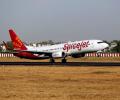
Aviation watchdog DGCA on Thursday decided to place crisis-hit SpiceJet under enhanced surveillance that will entail increased spot checks and night surveillance to ensure safety of the airline's operations. Based on reports of cancellation of flights and financial stress being experienced by SpiceJet, DGCA said it conducted a special audit of the airline's engineering facilities on August 7 and 8 and certain deficiencies were found during the audit.

When specifically asked about the reason for the crash and whether Air India is privy to any preliminary findings, Chandrasekaran said, "One would have to wait for the probe to conclude."
